


Over the centuries, Delhi has transformed from being a legendary capital to a thriving metropolis. How does the nation’s capital embody the mark of its diverse architectural and cultural legacy from various phases of historical development?
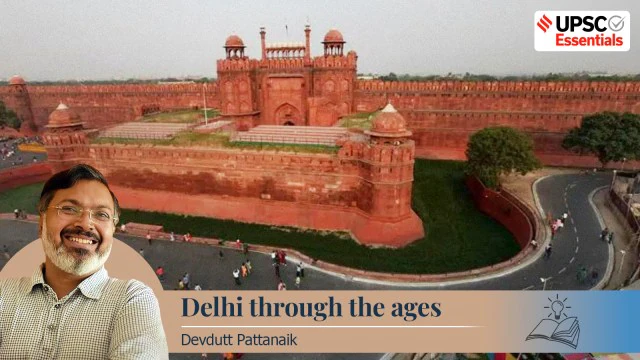
(The Indian Express has launched a new series of articles for UPSC aspirants written by seasoned writers and scholars on issues and concepts spanning History, Polity, International Relations, Art, Culture and Heritage, Environment, Geography, Science and Technology, and so on. Read and reflect with subject experts and boost your chance of cracking the much-coveted UPSC CSE. In the following article, Devdutt Pattanaik, a renowned writer who specialises in mythology and culture, traverses through many lives of Delhi.)
Art and Culture with Devdutt Pattanaik: A Walk Through Delhi’s Historical Tapestry
Delhi, the heart of India, is more than just a political capital—it’s a city where history breathes through ancient walls, art flourishes in every corner, and culture thrives across centuries. Exploring Delhi through the lens of renowned mythologist and cultural commentator Devdutt Pattanaik provides a fresh and insightful perspective on the city’s complex tapestry of history, art, and tradition.
Delhi: A City of Many Layers
Delhi’s history is like a richly woven fabric, stitched together by various dynasties, rulers, and empires. From the Pandavas’ legendary Indraprastha, through the reign of Mughal emperors, to British colonial rule, the city has seen immense transformation over the millennia.
Through Devdutt Pattanaik’s unique understanding of mythology and symbolism, Delhi’s cultural narrative becomes even more intriguing. Pattanaik’s work often deciphers the deeper meanings of mythology, illustrating how these ancient stories continue to shape contemporary culture. In the case of Delhi, the historical tapestry is inseparably linked to myths, architectural wonders, and cultural evolution.
Mythology in Architecture: The Sacred and the Secular
Delhi’s historical monuments are not just relics of the past but are also steeped in mythology and symbolism. Pattanaik, known for connecting mythological elements with historical structures, draws attention to how these grand edifices carry stories from India’s past.
The Qutub Minar
Take, for instance, the Qutub Minar, a UNESCO World Heritage Site. While commonly seen as a symbol of Delhi’s Islamic architecture, Pattanaik invites us to consider the deeper symbology behind such towering structures. Historically, it was built as a symbol of victory, but symbolically, towers like the Qutub often represent an axis mundi—a connection between the heavens and earth—a concept common in both Hindu and Islamic architecture.
Red Fort and the Mughal Grandeur
Moving to the Mughal era, Red Fort stands as a symbol of power and grandeur. Pattanaik might emphasize the parallels between the Mughal idea of kingship and Hindu notions of divinity. The Mughal emperors were seen as semi-divine figures, rulers blessed by God to govern on Earth. Red Fort, with its intricate art and imposing presence, not only reflected this divine kingship but also incorporated elements from different cultural traditions—Persian, Islamic, and Indian.
The Eternal Dharmic Influence on Delhi’s Culture
Delhi’s art and culture are inextricably linked with dharma—the concept of cosmic law and social order, which is central to Indian philosophical thought. Pattanaik often illustrates how dharma influences not just personal conduct but also architecture, art, and societal organization. The presence of temples, stupas, and ancient shrines throughout Delhi reflects this idea.
Lotus Temple: A Symbol of Unity
The Lotus Temple offers a modern interpretation of India’s ancient philosophies of unity and diversity. Designed to resemble a blooming lotus, the temple welcomes people of all faiths, resonating with the spirit of sarva dharma samabhava—equal respect for all religions. Pattanaik’s understanding of dharma helps us appreciate how this structure goes beyond its physical form to represent a spiritual metaphor, reinforcing the idea of unity amidst diversity—a value that Delhi’s culture has always embraced.

